
Right Plant, Wrong Place? Earth Almond / Chufa and Its Invasive Potential
Plant portraits
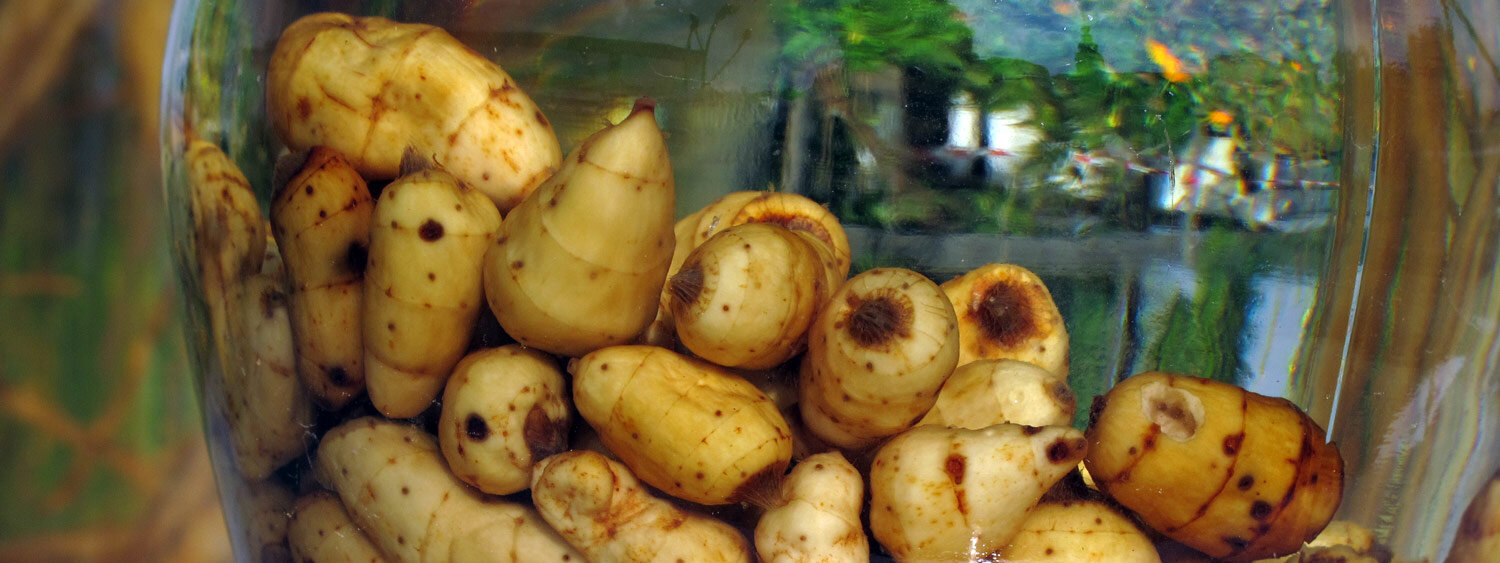
The earth almond is a plant full of contrasts. Its small, sweetish, nutty tubers have long been valued as food, and in Spain they are made into the well-known Horchata de Chufa. At the same time, Cyperus esculentus can spread persistently through these very tubers.
That is exactly why chufa is a fascinating example of mindful gardening for us. Because it shows that a plant is not simply “good” or “bad”. What matters is where and how we grow it and how well we know its biology.
An Ancient Crop with Edible Tubers
The earth almond, also known as chufa or tiger nut, bears the botanical name Cyperus esculentus. Despite its grass-like appearance, it does not belong to the true grasses but to the sedge family (Cyperaceae). Underground it forms small storage tubers that taste slightly sweet and nutty and can be used raw, dried, ground or roasted.
The earth almond is particularly well known from the Spanish region of Valencia. There the tubers are traditionally used for Horchata de Chufa, a drink made from earth almonds, water and sugar.
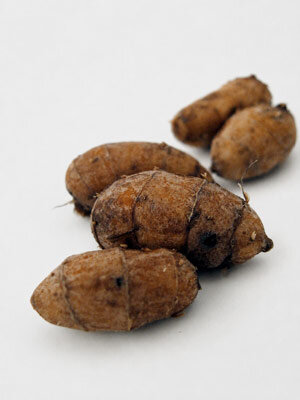
Incidentally, what is often sold as “chufa seeds” are, botanically speaking, not seeds at all but dried tubers. New plants sprout from them vegetatively. It is precisely this form of propagation that is decisive for the earth almond’s potential to spread.
Crop and Problem Plant at the Same Time?
The chufa we offer is traditionally referred to as Cyperus esculentus var. sativus. This classification is not used entirely consistently in science; in some cases it is described rather as a cultivated form within the species Cyperus esculentus.
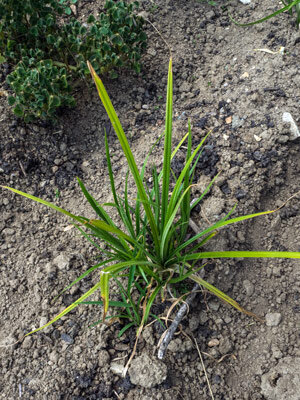
In the cultivated form, the focus is on producing large, easily usable tubers. Propagation from seed plays hardly any role in cultivation; we, too, have not yet observed any seed formation in our cultivated form.
However, this does not mean that the plant cannot spread. If a tuber remains unnoticed in the soil or is carried elsewhere with potting compost, garden compost or garden tools, a new plant can grow from it. The species is recorded in Germany as an established neophyte and can occur, particularly in agriculture, as a weed that is difficult to control.
Don’t just ask: “Can I grow this plant?” But also:
“What happens if a tuber leaves the place intended for it?”
When Earth Almond Becomes a Problem in Agriculture
In the home garden, chufa can easily be kept an eye on with attention and controlled cultivation. On agricultural land, however, Cyperus esculentus can behave quite differently. If the tubers get into arable soil, they can be spread further by tillage, soil, harvesting machines or other equipment.
The real problem lies underground: individual tubers can give rise to new plants, which in turn form numerous further tubers. The Flemish agricultural administration points out that, under favourable conditions, one plant can produce up to 1,000 tubers within a single season. Once established, a stand can therefore be difficult to control.
How seriously this potential to spread is taken becomes clear from a look at the Netherlands and Belgium.
Belgium: Obligations to Control It on Infested Land
In Flanders, special requirements apply to agricultural land infested with yellow nutsedge. On clearly infested land, restrictions may apply, among other things, to growing certain root, tuber and bulb crops. Farmers must also take measures to prevent further spread, for example cleaning machinery, working infested land last whenever possible and not taking contaminated soil onto other land.
Controlling yellow nutsedge has been part of the mandatory rules on integrated pest management there for years. This clearly shows that in agriculture the earth almond is regarded not merely as a troublesome weed, but as a plant whose further spread is to be actively prevented.
The Netherlands: Special Statutory Cultivation Rules
The Netherlands, too, has special statutory regulations for yellow nutsedge. The explicit aim of these rules is to prevent the plant from multiplying and spreading on agricultural land. Special requirements for cultivation, management and control therefore apply to the land concerned.
These regulations do not automatically mean that every cultivation of chufa in a private garden is prohibited. But they clearly illustrate the potential that Cyperus esculentus can develop when tubers get into agricultural soils uncontrolled and are carried further.
This is precisely the message of this plant portrait:
A valued crop can become a problem that is difficult to control under different conditions.
Why We Recommend Growing It in a Pot
If you want to get to know chufa and harvest it yourself, you can control its potential to spread much better through your choice of growing site. We therefore recommend a sufficiently large, sturdy container with controlled drainage.
In a container, the entire root zone is easier to keep track of at harvest time than in open garden soil. A root barrier in a bed, on the other hand, does not reliably prevent individual tubers from being carried elsewhere together with soil.
It is also important not to carelessly put used potting compost on open beds, out into the countryside or on an ordinary garden compost heap. Tubers can reach new sites via soil, tools and plant material.
Harvest Mindfully: So That No Tuber Gets Lost
With the earth almond, harvesting is at the same time part of controlling its spread. In autumn, when the foliage turns yellow and begins to dry out, the tubers can be harvested.
It is best to work over a large tub, tarpaulin or another closed surface. That way, small tubers will not fall unnoticed between paving stones or into neighbouring beds.
- First cut off the above-ground parts of the plant.
- Empty the entire root ball over a tub or tarpaulin.
- Carefully loosen the soil and collect the tubers as completely as possible.
- Also check fine roots and larger clumps of soil.
- Afterwards clean the container, saucer and any tools used.
- Keep an eye on the previous site again the following spring.
A few undamaged tubers can be stored dry, frost-free and clearly labelled as planting stock for the next season.
What at first sounds like special caution is actually a lovely example of conscious gardening: We do not only harvest what we want to use. We also take responsibility for what may be left behind.
Winter Won’t Necessarily Take Care of It
If you overlook individual tubers, you should not rely on frost to kill them reliably.
The above-ground foliage is sensitive to frost and usually dies back with the first harder frosts. Underground, by contrast, the tubers are much better protected from the cold by the soil. Tubers lying deeper in particular can survive a winter and sprout again in spring.
How well they survive frost depends, among other things, on soil depth, the duration and severity of the frost, soil moisture, snow cover and the particular plant form. In a container the protection is lower, because the entire root ball can freeze through more easily.
Frost can reduce the number of surviving tubers, but it does not guarantee complete elimination. A stand that appears to have died off has therefore not automatically disappeared. That is exactly why checking again the following spring is part of mindful cultivation.
Our Mindfulness Check for Chufa
- Where is the plant growing? A container you can control is preferable to an open bed.
- How does it spread? Mainly via its underground tubers.
- Can I harvest completely? As far as possible, small tubers should not be left behind in the potting compost.
- What happens to the soil? Do not carelessly put suspect potting compost on the compost heap or in other parts of the garden.
- Can I check again later? Keep an eye on the site in the following season too.
- Are there regional rules? In areas with problems caused by yellow nutsedge, special recommendations or statutory regulations may apply.
Right Plant, Right Place
The earth almond shows particularly clearly why plant knowledge is part of gardening. It is an interesting food plant with a long history of cultivation and, at the same time, part of a species whose vegetative spread deserves attention.
For us, responsible gardening therefore does not mean banishing unusual plants from the garden as a matter of principle. It means knowing their characteristics, naming possible risks openly and planning cultivation accordingly.
In our product descriptions, too, we want to make such connections as easy to understand as possible. We provide information on the origin and characteristics of our plants and point out when a species may, under certain conditions, have an increased potential to spread or become invasive.
Because for us, diversity and responsibility go hand in hand.
Which plant has ever surprised you with its urge to spread? We’d love to hear about your experience.
Sources and Further Information
- FloraWeb / German Federal Agency for Nature Conservation: information on Cyperus esculentus
- Julius Kühn Institute / OpenAgrar: specialist information on the introduction and spread of Cyperus esculentus
- Departement Landbouw & Zeevisserij Vlaanderen: information on Knolcyperus (yellow nutsedge) and measures on agricultural land
- Nederlandse Voedsel- en Warenautoriteit (NVWA): cultivation regulations for Knolcyperus
- PROSEA and specialist botanical literature on the cultivation and taxonomic classification of Cyperus esculentus