
Wild Teasel: A Small Garden Cosmos on Prickly Stems
Gardens of the future
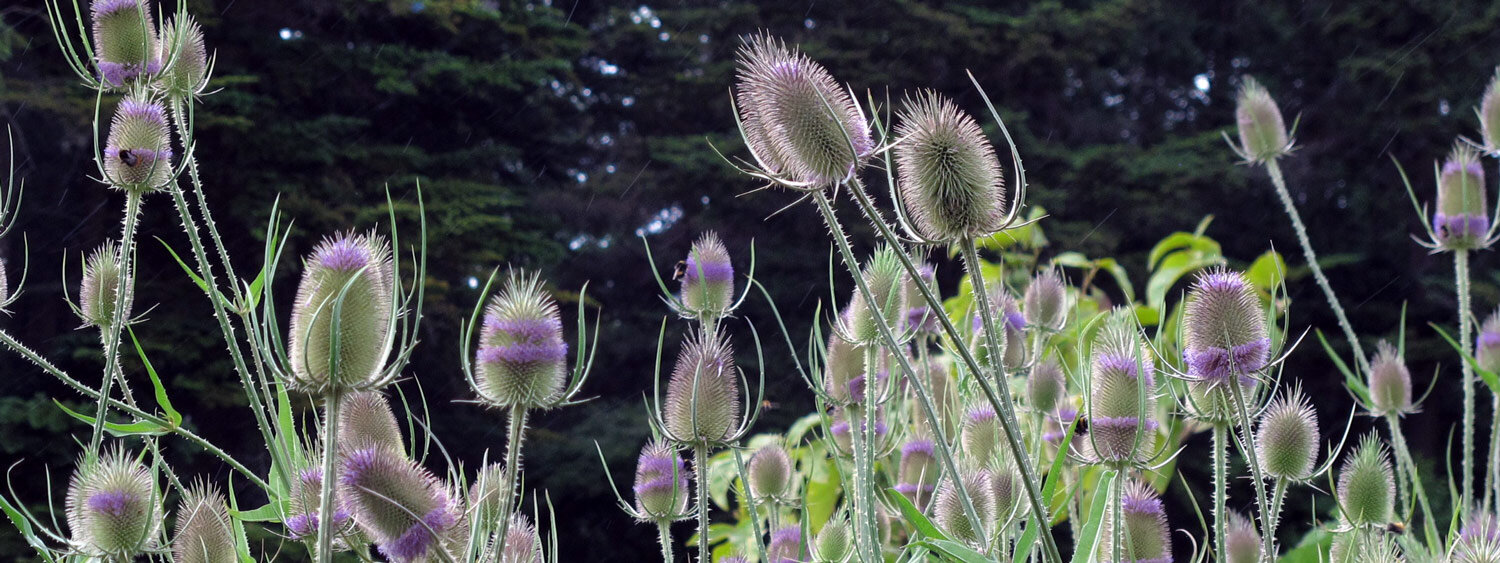
Some plants look as if they had stepped straight out of an old herbal: idiosyncratic, well-armed and full of secrets. Wild teasel (Dipsacus fullonum) is one such plant. With its tall stems, its prickly flower heads and its architectural silhouette, it brings wild beauty into the garden, and at the same time an astonishing amount of life.
At Magic Garden Seeds, we love plants that can do more than just look decorative: plants that promote biodiversity, preserve old knowledge and bring us closer to nature again. Wild teasel fits wonderfully with this idea, because it is not only an impressive wild plant but also a habitat, winter food, a watering place and a small ecological wonder.
From the Leaf Rosette Year to the Prickly Crown of Flowers
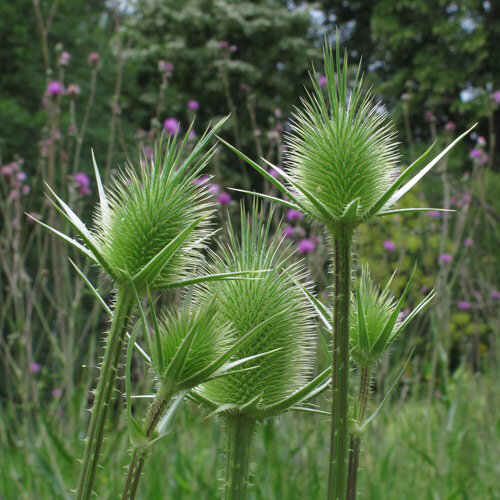
Wild teasel is biennial. In the first year, it stays close to the ground and forms a sturdy leaf rosette. In the second year, it grows upwards and develops its striking, prickly flower heads. In sunny, rather free-draining spots, it can reach impressive heights and quickly becomes an eye-catcher in the natural garden, the cottage garden or on the wild edge of a vegetable plot.
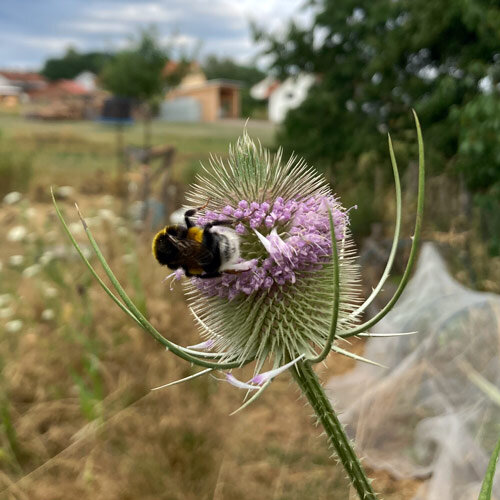
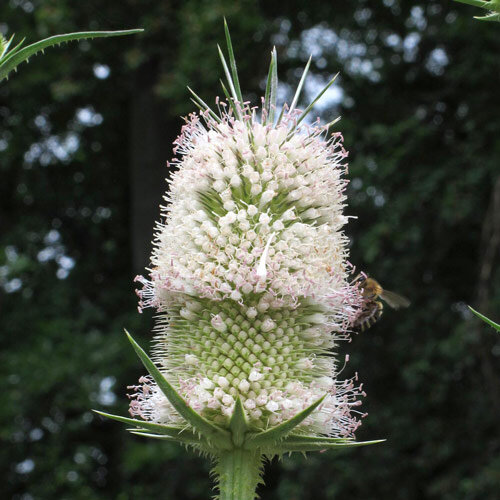
Its flowers usually appear in summer. Particularly beautiful is the violet floral wreath, which often opens in a ring around the flower head. Bumblebees, butterflies and other pollinating insects like to visit the flowers. But teasel has another special feature that you only discover when you look more closely: small water basins on the stem.
“Venus’s Basin”: Water Reservoir and Mini-Habitat
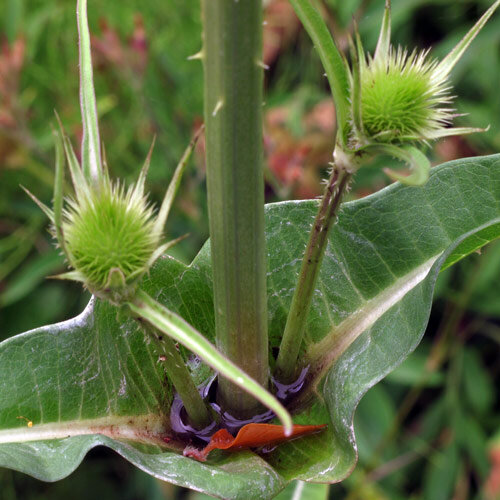
On the lower sections of the stem, the leaves sit in opposite pairs. Their leaf bases are fused together in such a way that they form small cup-shaped basins. Rainwater collects in them. In botany, such tiny bodies of water formed by plants are called phytotelmata. In teasel, they are sometimes also poetically referred to as “Venus’s basin”.
These water basins are much more than a botanical curiosity. They fulfil several ecological functions at the same time. On the one hand, they probably act as a natural barrier: ants, aphids and other crawling insects cannot easily climb up the stem. In this way, flowers, young plant parts, nectar and pollen are better protected. For pollinating insects such as bumblebees and butterflies, this can be an advantage, because teasel partly keeps uninvited nectar thieves at a distance.
On the other hand, the small pools of water themselves become habitats. Algae, microorganisms and small larvae can develop in them. Sometimes drowned insects are also found in the basins, which are in turn broken down by microorganisms. In this way, a tiny, hidden ecosystem forms on every plant: water, life, decomposition, nutrients, and in the middle of it all a plant that integrates all of this into its yearly cycle.
Especially in dry summers, these small water stores can be valuable for animals in the garden. Small birds such as tits or robins can use them as a natural drinking place, and snails or other small garden dwellers are also observed at such watering places. Wild teasel is therefore not only a flowering plant but also a kind of tiny garden spring.
Is Wild Teasel Carnivorous?
Because drowned insects often lie in teasel’s water basins, it was suspected early on that the plant might feed on them in a similar way to a carnivorous plant. But it is not quite that simple.
Studies suggest that dead insects in the water basins can have a positive effect on teasel’s seed production. In investigations, plants whose basins retained insect remains produced more seeds. However, this does not automatically make teasel a classic carnivorous plant like the sundew or the Venus flytrap.
According to current understanding, it does not produce the typical digestive enzymes that actively break down prey. It is more likely that microorganisms in the water basins play a role in decomposing the insect remains and that the released nutrients benefit the plant indirectly. Exactly how this works has not yet been fully explained, and that is precisely what makes wild teasel so fascinating. It stands in the middle of the garden and reminds us that even familiar wild plants still hold mysteries.
A Winter Buffet for Goldfinches
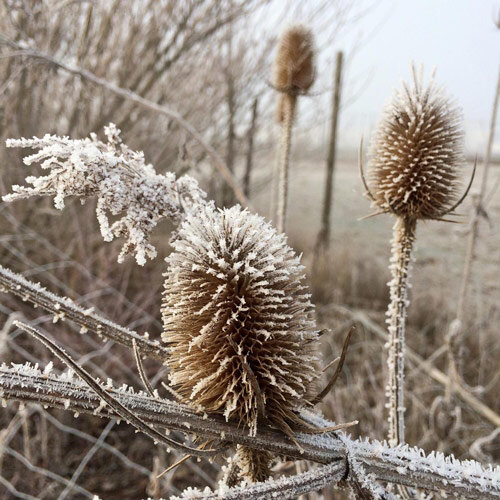
In autumn and winter, wild teasel shows its next great value. While many gardens have already been tidied up, its dry seed heads remain standing firmly. For the goldfinch, known in German as Distelfink (“thistle finch”), they are a wonderful food source.
With its fine, tweezer-like beak, the goldfinch picks the small seeds out of the prickly heads. Other seed-eaters such as finches, sparrows and buntings also use the seed heads of wild plants when natural food is scarce. Where teasels, thistles and other seed-rich wild plants are allowed to grow, birds still find food even in winter.
That is why the rule in a bird-friendly garden is: please do not cut teasels back in autumn. The seed heads may stay standing over the winter. They are a food source, a perch, winter decoration and a living link between garden and wilderness.
Sowing and Position
Wild teasel loves sunny positions and copes well with rather free-draining soils. It suits garden edges, fences, wildflower areas, dry stone walls or wildlife-friendly perennial beds. As it is biennial, a little patience is needed: in the first year the rosette grows, and in the second year the flowers follow.
If some seed heads are allowed to ripen fully, teasel often self-seeds. In small gardens, you can deliberately leave just a few plants standing and remove surplus young plants. This keeps the balance between wild abundance and garden design.
Discover Wild Teasel / Fuller's Teasel (Dipsacus fullonum) organic seeds at Magic Garden Seeds
Don’t Tidy Up: Watch!
Wild teasel is a wonderful example of how much ecological richness arises when we don’t immediately cut, weed and tidy everything. Its flowers feed insects. Its water basins form mini-habitats. Its seed heads feed birds. And in winter, its prickly heads wear hoar frost like little crowns.
If you would like to make your garden more natural, more bird-friendly and more alive, wild teasel is a wonderful companion. Sow it in a sunny spot, let it unfold its two-year rhythm, and watch who comes along.
Discover open-pollinated seeds for wildlife-friendly gardens at Magic Garden Seeds and invite more wildness, diversity and joy in nature into your garden.