
Right Plant, Right Place? Four Garden Plants with Surprising Potential to Spread
Gardening Knowledge
Some plants surprise us not with their flowers or their flavour, but with their success. They grow vigorously, self-seed reliably or suddenly turn up in places where we never planted them.
In your own garden, that can be a nuisance. But does a vigorous plant therefore automatically mean that it is invasive?
No.
This is exactly where a closer look pays off. Because there are important differences between a rampant garden plant, an established neophyte and a genuinely invasive species. At the same time, it becomes clear again and again: a plant that seems unproblematic here can behave quite differently under other climatic or ecological conditions.
Four very different garden plants show particularly clearly why origin alone says little, and why position, climate and dispersal strategy are so decisive.
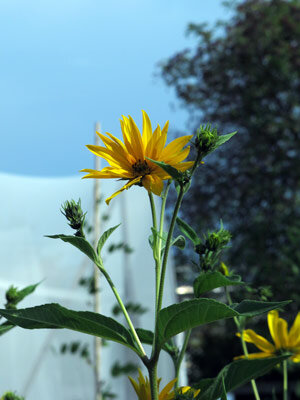
Jerusalem Artichoke (Helianthus tuberosus)
Jerusalem Artichoke: Delicious Tuber with an Urge for Freedom
Jerusalem artichoke (Helianthus tuberosus) is a crop plant with a long tradition from North America. Below ground it forms edible tubers that can be harvested in autumn and winter. But it is precisely these tubers that are the reason why Jerusalem artichoke sometimes hangs on in the garden more stubbornly than planned.
Even small tubers overlooked at harvest can sprout again the following year. Once established, a stand can therefore persist for years and gradually spread.
Outside gardens, too, Jerusalem artichoke now occurs permanently in Germany. Larger stands can develop especially on riverbanks and on disturbed ground. In nature conservation assessments, the species is therefore not simply regarded as a harmless cultivated plant.
In the garden, Jerusalem artichoke can still be put to good use, provided the position is chosen deliberately and the tubers can be harvested regularly and as completely as possible.
The lesson of the Jerusalem artichoke:
What we want to harvest can at the same time be a plant’s most important means of spreading.
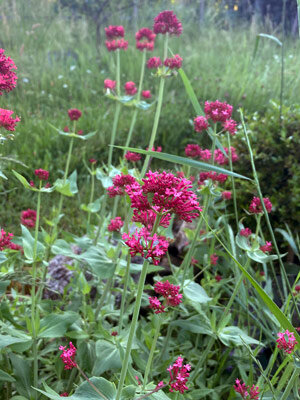
Red Valerian: Adaptable, and Carried by the Wind
Red valerian (Centranthus ruber) at first seems like an uncomplicated garden plant. It copes well with dry, warm and nutrient-poor sites, grows in cracks in walls, on gravel areas and on sunny slopes, and can hold its own there astonishingly successfully.
Particularly interesting is the combination of two characteristics: it is very adaptable and assertive, and its seeds are dispersed by the wind.
It is precisely this combination that can enable it to reach new sites comparatively easily. While tubers or runners can be at least partly controlled with containers, root barriers or careful harvesting, spread by the wind is much harder to limit.
If you want to prevent heavy self-seeding, you would have to remove faded flower heads in good time, before the seeds ripen. With larger stands or wildlife-friendly plantings, however, this can hardly be fully controlled.
In Germany, red valerian is a neophyte and is not to be equated with the invasive species that are particularly problematic there. Under other climatic conditions, however, the same plant can be assessed differently. In the Canary Islands, it is considered an invasive non-native species and is subject to legal restrictions there.
This example in particular makes it clear that invasiveness is not a fixed characteristic that attaches to a plant equally everywhere.
The lesson of red valerian:
Plants can become especially successful when high adaptability and an effective dispersal strategy come together.
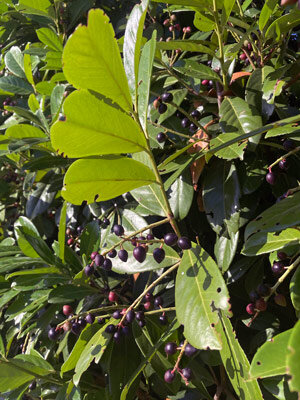
Cherry Laurel (Prunus laurocerasus)
Cherry Laurel: Familiar Hedge with Ecological Downsides
Hardly any garden plant seems as commonplace as cherry laurel (Prunus laurocerasus). Its evergreen leaves, fast growth and good tolerance of pruning have made it a popular hedging plant for decades.
But cherry laurel does not always stay behind the garden fence. Birds eat its fruits and can carry the seeds into woodland, scrub and other near-natural areas. There the plant can become established and, under favourable conditions, form dense evergreen stands.
A common criticism is that cherry laurel is fundamentally worthless for native insects. It is not quite that simple, though. Its flowers can certainly be visited by bees and other pollinators.
The bigger ecological problem lies elsewhere: ecologically, a cherry laurel hedge cannot be equated with a diverse hedge of native woody plants. Native shrubs have been linked with numerous animal species over a long period. They serve not only as a nectar source but also, for example, as food for specialised caterpillars and other herbivores, and they offer fruits, hiding places and varied structures.
At the same time, cherry laurel can impair natural vegetation outside the garden. In woodland close to settlements, dense stands can change the amount of light reaching the ground and make natural regeneration of other woody plants more difficult.
The difference in assessment becomes particularly clear when you look at Switzerland: there, cherry laurel is classified as an invasive neophyte and, since 2024, may no longer be placed on the market for direct use in the environment.
This does not mean that every existing cherry laurel hedge in Germany suddenly becomes an ecological disaster. But it does show that even a garden plant that has been familiar for decades can be reassessed when its spread outside gardens increases.
The lesson of the cherry laurel:
A popular garden plant can indeed offer food for some insects, and still cause ecological problems outside the garden.
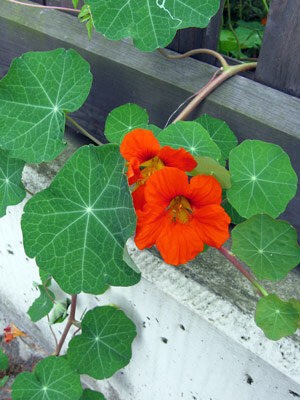
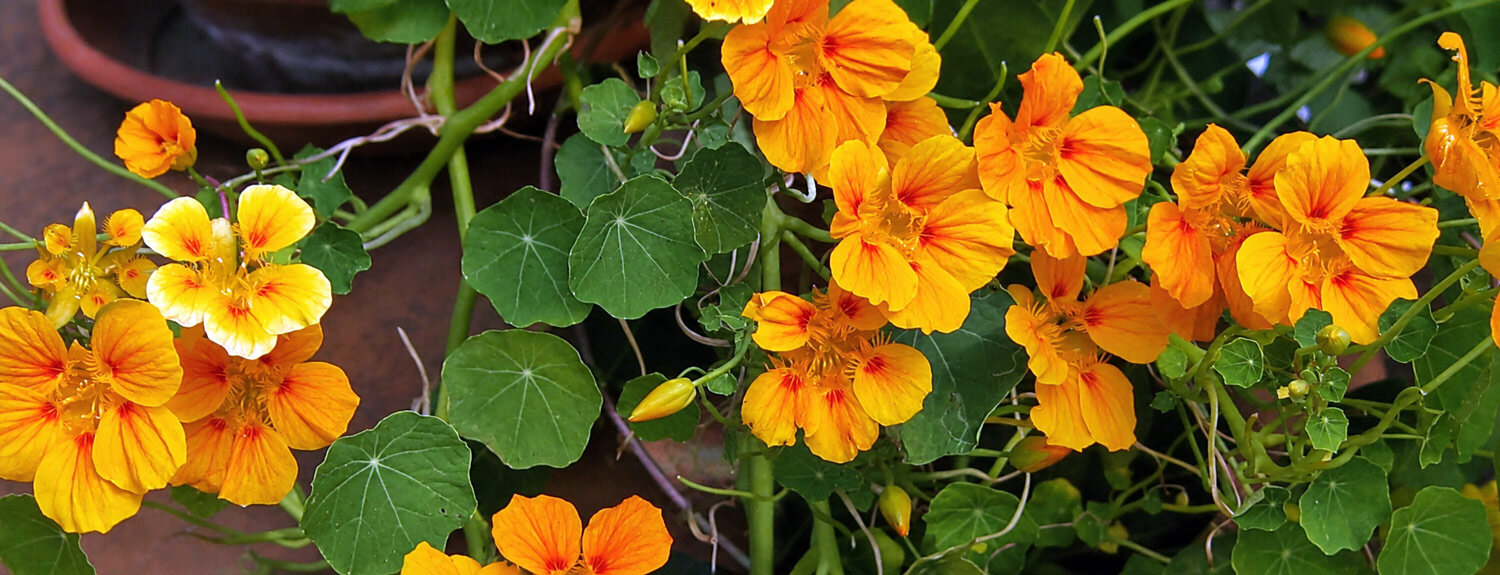
Nasturtium: Invasive? Hard to Imagine Here
And then there are plants for which the label ‘invasive’ at first seems almost absurd in Germany.
For many people, the garden nasturtium (Tropaeolum majus) belongs to the summer garden just like tomatoes and marigolds. It grows quickly, forms lush trailing stems, its flowers and leaves are edible, and by the time of the first hard frost at the latest, its season in Central Europe is usually over.
How could this of all plants become invasive?
The answer lies above all in the climate.
In regions without our cold winters, nasturtium can behave quite differently. There it lacks the natural limit set by frost. Under favourable conditions it can survive permanently, naturalise and form dense stands.
In various mild and subtropical regions of the world, Tropaeolum majus is therefore observed as a naturalised or invasive plant.
For gardeners in Germany, this does not mean that nasturtium suddenly has to be regarded as problematic. But that is exactly why it is a particularly valuable example: our personal experience with a plant does not automatically apply to other regions of the world.
Frost, rainfall, altitude, competition from other plants and available habitats all help decide whether a species disappears after one season, or gains a permanent foothold.
The lesson of the nasturtium:
A plant that is reliably kept in check by winter here can develop completely different dynamics in a frost-free climate.
Four Plants, Four Different Stories
Our four examples cannot simply be lumped together.
- Jerusalem artichoke shows how a crop plant can establish itself permanently through underground storage organs.
- Red valerian makes visible how a combination of adaptability and wind dispersal favours spread, and how strongly the assessment can depend on region and climate.
- Cherry laurel stands for a very familiar garden plant whose spread into near-natural habitats is increasingly viewed critically.
- Nasturtium shows surprisingly clearly how decisive climatic limits can be for the behaviour of a species.
That is exactly why it is important not to mix up the terms.
Not every plant that runs rampant is invasive, and not every familiar garden plant is automatically harmless outside the garden.
Is My Plant Rampant, or Is It Invasive?
A mint that takes over half the herb garden can be extremely annoying. Even so, that does not make it an invasive species in the nature conservation sense.
‘Invasive’ does not simply mean ‘grows vigorously’.
What matters, rather, is whether a non-native species can establish itself and spread outside cultivation, and whether negative effects on biodiversity arise or are to be expected as a result.
For us as gardeners, this gives rise to a very simple but helpful question:
What happens if this plant leaves the place intended for it?
Our Mindfulness Check Before Planting
- How does the plant reproduce?
By seeds, tubers, rhizomes, runners or pieces of root? - How easily can it leave the garden?
Can wind, birds, water, soil or garden waste spread it? - How far does my control reach?
Tubers can perhaps be harvested carefully and seed heads cut off, but wind and birds can hardly be contained. - What lies next to my garden?
Woodland, water bodies, dry grassland or other sensitive habitats deserve special attention. - How does the species behave in my region?
A plant may need to be assessed completely differently in Central Europe than in the Mediterranean region or on a subtropical island. - Are there current recommendations or legal requirements?
Assessments can change when new findings about the spread of a species become available.
Diversity Does Not Need Simple Pigeonholes
Anyone who loves special plants inevitably comes across species from the most varied regions of the world. It is precisely this diversity that makes our gardens exciting.
For us, gardening responsibly therefore does not mean rejecting everything non-native. It means looking more closely.
Where does a plant come from? How does it reproduce? What happens when it leaves the garden? And could its role change if the climate or site conditions change?
At Magic Garden Seeds, we want to pass on this kind of information as transparently as possible and point out a particular potential to spread wherever there is reason to do so.
Because sometimes there is above all one thing between a wonderful garden plant and a problematic species: the wrong place.
Which plant has ever surprised you because it spread much more than you had expected? Feel free to share your experience with us.
Sources and Further Information
- German Federal Agency for Nature Conservation (Bundesamt für Naturschutz, BfN): information and nature conservation invasiveness assessments of non-native vascular plants in Germany
- Ministerio para la Transición Ecológica y el Reto Demográfico (Spain): information on Centranthus ruber and invasive non-native species in the Canary Islands
- Info Flora Switzerland: information on the spread, assessment and legal situation of Prunus laurocerasus