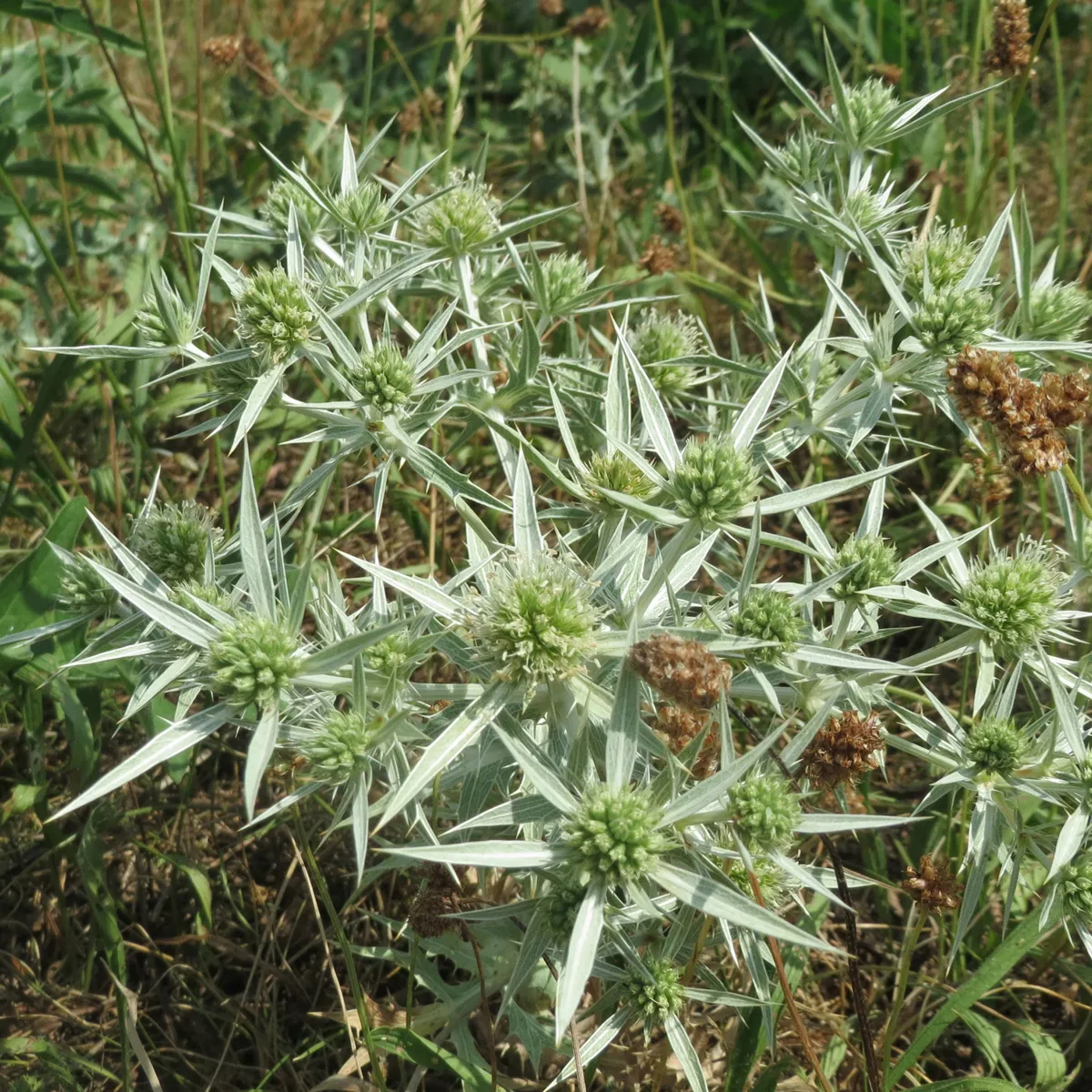
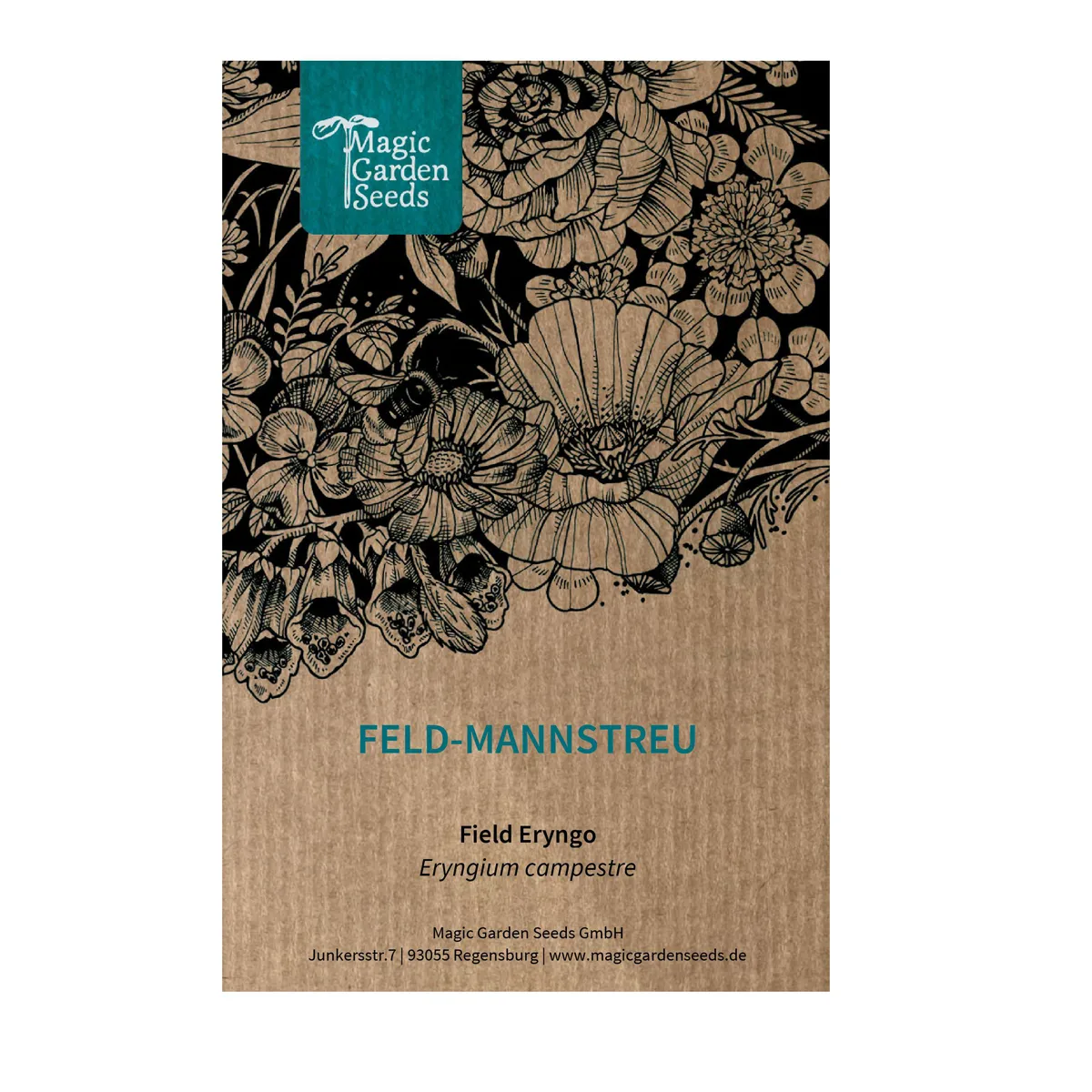
Field Eryngo (Eryngium campestre) seeds
- Diese stachelige Schönheit sieht aus wie eine Distel, gehört aber zur Familie der Doldenblütler.
- Contents: Approx. 200 seeds.
- Open-pollinated variety, seed tested regularly.
Regular price:
€2.59
Product number: ERY03 GTIN: 4251420520463
Description
Field Eryngo, also known as Watling Street Thistle, is an extraordinary wild plant characterised by its striking appearance and robust properties. This spiny beauty resembles a thistle, but belongs to the Apiaceae family (Umbellifers) and is native to many parts of Europe, Asia, and North Africa. It thrives on dry meadows, pastures, and roadsides, making it a true survivor in arid, sunny landscapes.
The plant, which can reach up to 80 cm in height, is distinguished by its thorny, grey-green leaves and spherical, spiny flower heads that display a greenish hue from June to September. These distinctive flower heads are not only visually captivating but also serve as an important food source for bees and other pollinating insects. Its thorny growth further protects the plant from herbivores, making it particularly resilient.
Eryngium campestre is extremely low-maintenance and prefers sunny, dry locations with nutrient-poor, well-drained soils. It is perfect for rock gardens, dry beds, or naturalised areas. The plant requires very little water and is highly resistant to drought and heat. Pruning is not necessary – on the contrary, the dried flower heads remain an attractive feature in the garden even during winter.
In addition to its use as an ornamental plant, it has also been consumed as a wild vegetable: young shoots and roots are edible and were historically prepared as a vegetable. In folk medicine, Field Eryngo was used as a medicinal plant to treat coughs, digestive issues, and bladder disorders, particularly due to the diuretic properties of its root.
Plant profile
| Plant type | Herbaceous plant, Wildflower |
|---|---|
| Use | Dried flower, Edible plant, Good insect food plant, Medicinal plant, Ornamental plant |
| Lifecycle | Perennial |
| Species | Apiaceae |
| Seed propagation | konventionell |
| Region of origin | Afghanistan, Caucasus, Central Europe, Eastern Europe, Iran, Mediterranean Region, North Africa, Southern Europe |
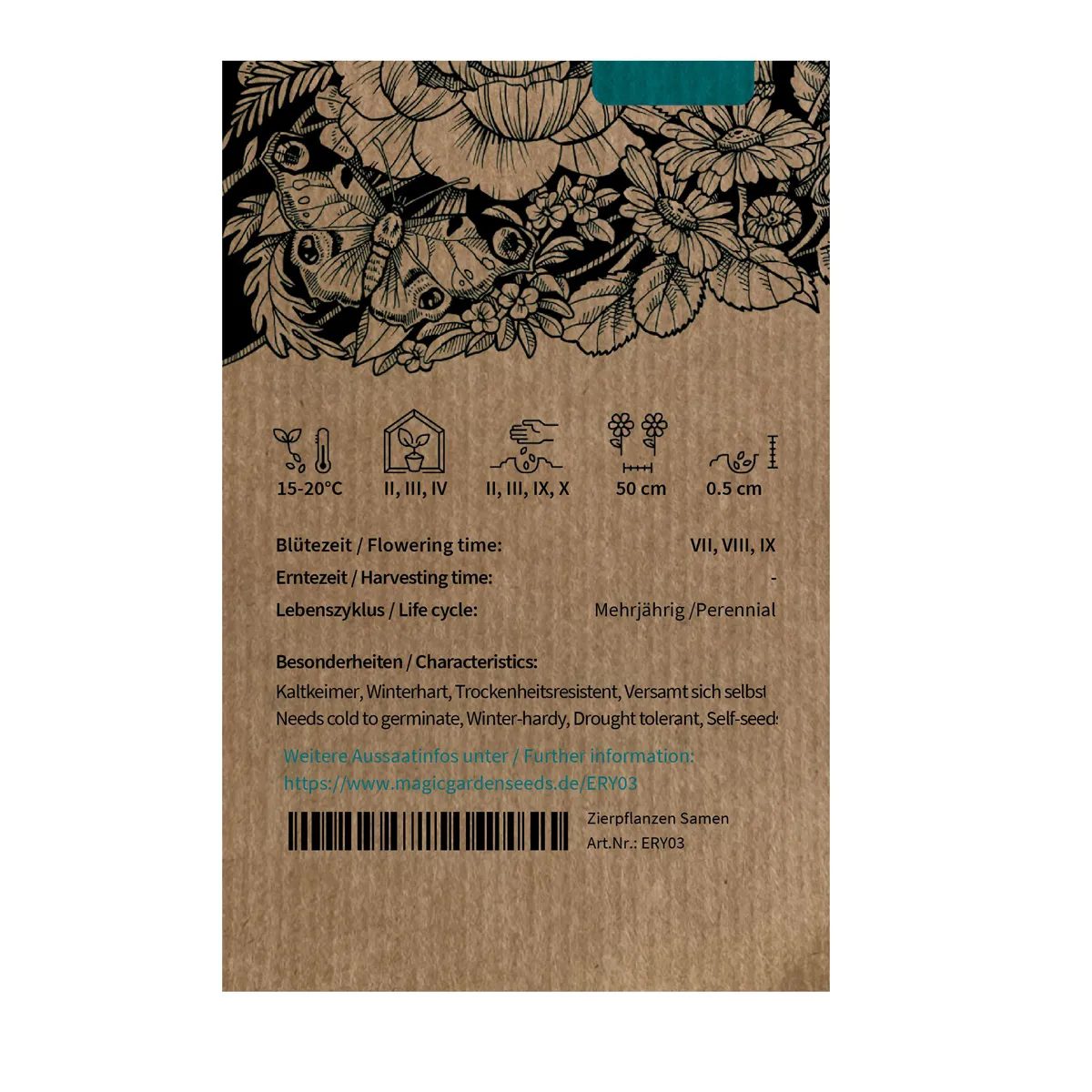
| Characteristics | Drought tolerant, Needs cold to germinate, Self-seeds, Winter-hardy |
| Eventual height | 40-80 cm |
| Flower colour | Green |
| Flowering months | August, July, September |
| Root system | Deep roots, Taproot |
| Winter hardiness zones | 5 (-30 bis -23 °C) |
Growing instructions
| When to sow outdoors | February, March, October, September |
|---|---|
| Sowing depth | 0.5 cm |
| Germination temperature | 15-20°C |
| Germination time | 1-3 months |
| Climate | Dry, Temperate |
| Soil type | Chalky, Dry, Free-draining, No waterlogging, Undemanding |
| Sunlight | Full sun |
| Water requirement | Low, No waterlogging |
| Planting distance | 50 cm |
Sowing and care
Field eryngo should be sown in autumn or early spring, as the seeds require a period of cold to germinate. A sunny, well-drained site with sandy or stony soil is ideal. Sow the seeds thinly and cover them lightly with soil. Germination takes approximately 4 to 6 weeks. Once established, the plant is low-maintenance and highly drought-tolerant. Artificial stratification of the seeds is also possible.
Other names
Botanical name: Eryngium campestre, Eryngium officinale, Eryngium vulgare
German: Feldmannstreu, Donardistel, Brachdistel, Steppenhexe, Steppenroller, Krausdistel
English: Field Eryngo, Watling Street Thistle, Dane's Flower, Dane's Weed
Reviews
Login
No reviews yet. Will you write the first one?