Sustainable watering on your balcony: how to care for your plants in harmony with nature
The Grow-your-own-food
In spring, everything begins so easily. The soil is moist, the sun still gentle, and your plants grow almost by themselves.
But by summer at the latest, everything changes: the heat increases, the pots dry out faster, and suddenly watering becomes a daily chore.
This is exactly where sustainable gardening begins. With the right methods, you can not only save water, but also make your plants healthier and more independent.
Sustainable watering means: less effort, less consumption, and a closer connection to your plants.
Contents
- 1. Why sustainable watering matters so much
- 2. Watering in harmony with the plant
- 3. Using water storage in the pot
- 4. Mulching in pots
- 5. Collecting rainwater in the city
- 6. DIY watering
- 7. Automatic watering systems
- 8. Costs & materials
- 9. Water tank & weight
- 10. Watering by plant type
- 11. Conclusion
1. Why sustainable watering matters so much
On a balcony, plants depend entirely on you. Unlike in the garden, their roots cannot reach deeper layers of water, so they live solely on what you give them.
Especially in hot summers, extremes quickly develop: the compost dries out, plants become stressed, and you have to reach for the watering can more and more often.
Sustainable watering helps you balance exactly that. It provides even moisture, saves water and creates stable conditions, even in the heat.
2. Watering in harmony with the plant
The most important foundation is not technology, but observation.
- It is best to water in the morning
- Water thoroughly rather than often
- Let the surface dry out slightly in between
A simple trick: push your finger a few centimetres into the compost. If it still feels moist there, you can wait.
This is how you develop a feel for your plants, and that is exactly the most sustainable form of gardening.
3. Using water storage in the pot
A healthy balcony begins in the pot. The right compost can store water and release it slowly again.
- Use compost-rich potting compost
- Mix in expanded clay or perlite
- choose structurally stable composts
- work unwashed sheep's wool into the compost
The better your compost performs, the less you have to water, and the more stably your plants grow.
4. Mulching in pots: underrated and incredibly effective
Mulching works in pots too, and it is one of the simplest tricks for sustainable watering.
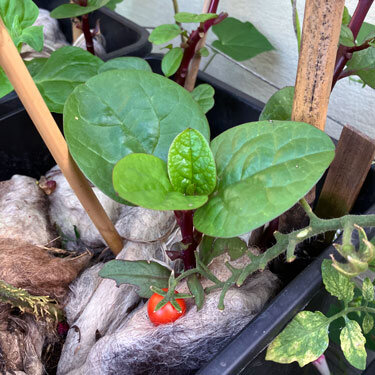
A layer of straw, leaves or plant debris 3 to 5 cm thick can noticeably reduce evaporation.
Mulch:
- keeps moisture in the soil
- protects from heat
- encourages a thriving soil environment
Especially on sunny balconies, this is a real game changer. Untreated sheep's wool can also be used very well as a mulch layer and water store.
5. Collecting rainwater in the city
You can use rainwater on a balcony too.
- Set up buckets or small barrels
- Catch the rain deliberately
- distribute it with a watering can
Rainwater is soft, low in lime and ideal for plants. At the same time, you noticeably reduce your drinking water consumption.
6. DIY watering: simple & effective
You don't always need a ready-made system. You can easily build many watering solutions yourself, with materials you often already have at home.
These DIY methods are ideal for small balconies, single plants, or when you are away for a few days.
PET bottles as water dispensers
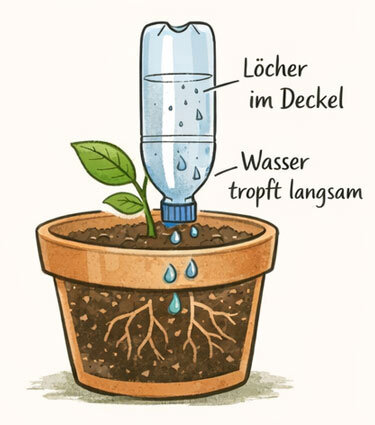
One of the simplest solutions: you take an empty plastic bottle, poke small holes in the lid and push it upside down into the compost.
- Water is released slowly to the roots
- depending on the size of the holes, the supply lasts several days
- ideal for larger pots (e.g. tomatoes)
Tip: Test the hole size beforehand, as holes that are too large let the water run out too quickly.
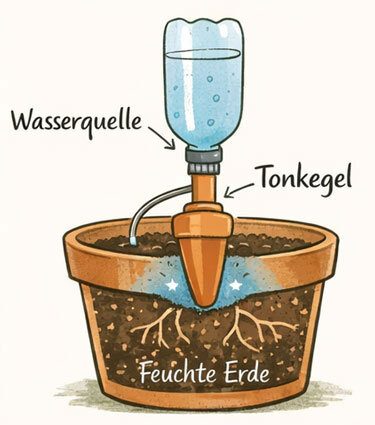
Clay cones (watering spikes)
Clay cones work like a natural water dispenser. They are pushed into the compost and connected to a water source (e.g. a bottle).
- the clay releases water slowly and evenly
- adapts to the moisture needs of the compost
- particularly good for herbs and an even supply
This solution is somewhat more reliable than plain DIY bottles and very easy to use.
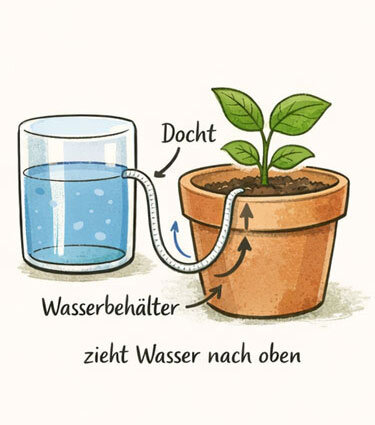
Wick or capillary system
Here you use a piece of fabric or a string as a “water conductor”: one end sits in a water container, the other is pushed into the compost.
- Water is drawn continuously into the pot
- works entirely without technology or electricity
- ideal for small pots and window boxes
Important: The water container should stand slightly higher than the pot, as the water flows better that way.
Conclusion: With simple means, you can supply your plants reliably. Often a small DIY solution is enough to make watering your balcony much more relaxed.
7. Automatic watering systems
If you want to water your balcony efficiently in the long term, an automatic system is worthwhile. Such systems save time, reduce water consumption and supply your plants more evenly, but depending on the type they also have their limits.
| System | How it works | Advantages | Disadvantages | Suitable for |
|---|---|---|---|---|
| Drip irrigation (e.g. Blumat) | Water is delivered directly to the roots via clay cones or hoses, often controlled by soil moisture |
|
| Herbs, vegetables, larger balconies |
| Solar watering systems | A small pump distributes water automatically from a tank, powered by solar energy |
|
| Medium to large balconies |
| Capillary systems (wick / mat) | Water is drawn from a reservoir into the pots via fabric or mats |
|
| Herbs, small pots, indoors & balcony |
| Water tank with drippers | A tank placed higher up supplies plants via hoses using natural water pressure |
|
| All balconies with several plants |
Tip: The most effective combination is often: mulch + drip irrigation + rainwater. This reduces evaporation, saves water and creates stable conditions for your plants.
8. Costs & materials: what do you really need?
Watering doesn't have to be expensive. There are solutions for every budget:
- DIY: €0 to €10
- Simple systems: €15 to €50
- Automatic systems: €50 to €150
You can start small and expand your system step by step.
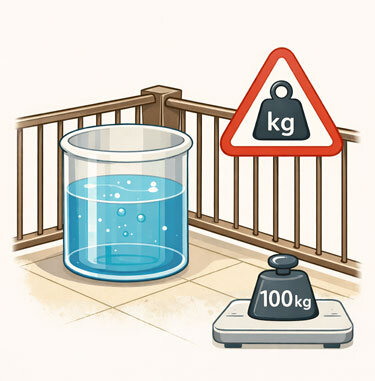
9. Water tank on the balcony: mind the weight!
A central water tank is practical, but heavy.
- 10 litres = 10 kg
- 20 litres = 20 kg
- 50 litres = 50 kg
So the following applies:
- Distribute the weight evenly
- Place the tank close to the wall
- use several small tanks instead
A 20 to 30 litre tank is often entirely sufficient.
10. Watering by plant type
Not every plant has the same needs. While tomatoes need a lot of water, Mediterranean herbs get by with much less. If you adapt your watering to the plant types, you save water and get healthier plants.
| Plant type | Water requirement | Recommended system | Special features |
|---|---|---|---|
| Herbs (Mediterranean, e.g. rosemary, thyme) | low | Clay cones, economical drip irrigation |
|
| Herbs (soft, e.g. basil, parsley) | medium | small drip systems or wick watering |
|
| Lettuces & leafy greens | medium to high | Drip irrigation or capillary systems |
|
| Tomatoes & fruiting vegetables | high | Drip irrigation + mulch |
|
| Cucumbers & courgettes | very high | automatic drip irrigation |
|
| Flowering plants (e.g. petunias, pelargoniums) | medium to high | Drip irrigation or regular manual watering |
|
| Wildflowers & pollinator plants | low to medium | occasional watering or simple systems |
|
| Climbing plants | medium to high | Solar drip systems or drip irrigation |
|
Tip: If you combine different plant types, group them by water requirement. This lets you control your watering more precisely and save water at the same time.
11. Conclusion
Sustainable watering is not a complicated system, but an interplay.
When you understand your plants, choose the right materials and use simple solutions, a stable balance emerges.
And that is exactly where the magic lies: your balcony becomes a living, self-sustaining little wilderness.